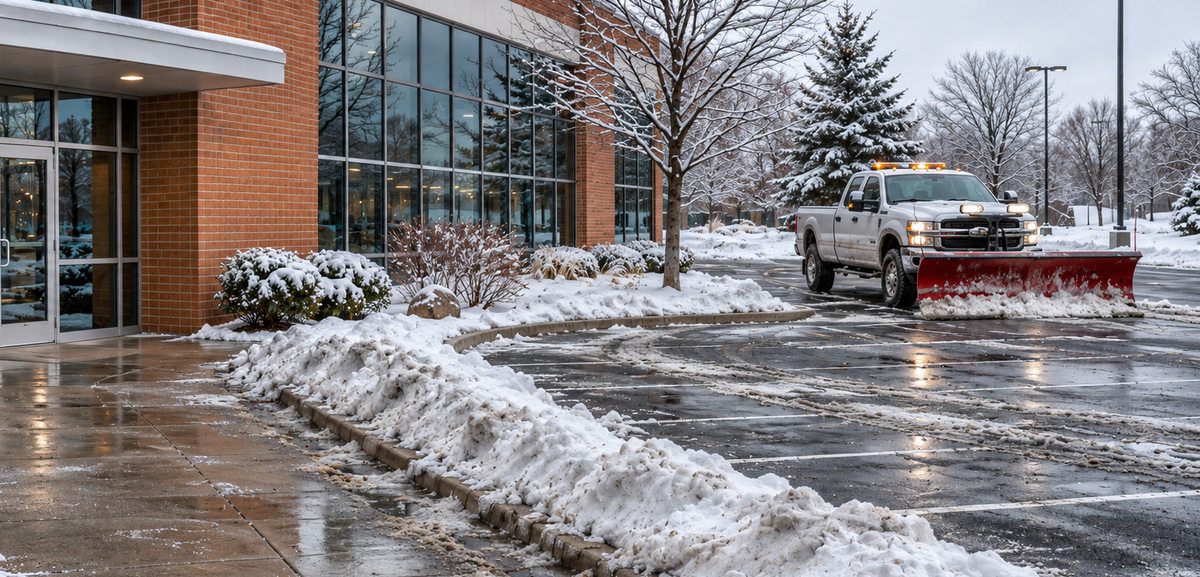
What makes a good commercial snow removal company?
For a property manager, winter maintenance is about more than getting a parking lot plowed after a storm. It is about keeping planned access routes usable, understanding what service is covered, and having a clear point of contact when Michigan weather changes quickly.
Look for a snow removal company that provides a property-specific plan, a clearly written scope of work, dependable communication, appropriate equipment, and transparent contract terms. Price matters, but the lowest quote may leave important sidewalks, ice treatments, or additional services out of the agreement.
If you manage an office, retail center, professional building, or other commercial property in Plymouth, Northville, Novi, Livonia, or nearby Southeast Michigan communities, these are the questions worth asking before you sign.
1. Will the contractor review your property before proposing service?
Commercial properties do not all operate the same way. A retail lot may need certain parking areas available early in the morning, while a professional office may have busier weekday arrival times. A property with multiple entrances or delivery bays has different priorities than a single-building site.
Ask the contractor to review your layout and discuss:
- Main parking areas and access drives
- Pedestrian walkways, sidewalks, and building entrances
- Accessible parking and designated accessible routes
- Delivery zones, loading docks, and other priority areas
- Acceptable locations for snow piles and areas that must stay clear
A site-specific plan helps avoid misunderstandings about what will be serviced. Transitions Outdoor Services develops winter maintenance proposals around designated areas and the needs of each property, with snow clearing and ice management services defined in the agreement.
2. Does the quote cover snow plowing, sidewalks, and ice management?
One of the easiest mistakes when comparing proposals is assuming that “snow removal” includes everything. Parking-lot plowing is only one piece of winter maintenance. Sidewalk clearing, parking-lot salt applications, and sidewalk deicing may be included, optional, or separately billed.
Ask the company to list the exact areas and services in writing. For example, who will clear the main walkway after the parking lot is plowed? Who decides whether salt should be applied? Are entrances and pedestrian areas included in the agreed scope?
At Transitions, commercial services can include designated snow plowing, sidewalk snow clearing, salt applications, and sidewalk deicing. Which services are included depends on the customer's proposal and contract option.
3. How will service work during a storm?
Do not settle for a vague promise that the crew will arrive “when it snows.” Ask how the service plan works during light snow, heavy accumulation, storms that continue throughout the day, and freezing conditions after the snow stops.
Useful questions include:
- What snowfall or weather conditions trigger service under our agreement?
- How are priority areas handled when snow continues falling?
- What should we expect during overnight storms or before business opening?
- How are requests, changes, or concerns communicated?
The exact expectations should be documented in the agreement. Having them in writing gives both your staff and the service provider a clearer understanding of what is expected.
4. What is the plan for ice, not just snow?
In Southeast Michigan, winter conditions can change quickly. A daytime thaw followed by a cold night may leave slippery areas even when no new snow has fallen. Entrances, sidewalks, shaded spots, and frequently used walking routes deserve particular attention.
Ask how the company evaluates the need for parking-lot salting and sidewalk deicing. Make sure you know whether treatments are automatic under the contract, performed according to agreed conditions, or billed as separate applications.
It is also worth asking about freezing rain and other ice events. These can have different coverage or billing rules from ordinary snow clearing. A good proposal will make those differences understandable before winter begins.
5. Does the provider have the equipment and communication process your site needs?
The equipment needed for a narrow access drive is not necessarily the same as what is needed for a larger commercial lot. Ask whether the company has suitable equipment for the property's size, layout, and contracted services.
Communication matters just as much. You should know who to contact if a delivery entrance needs attention, if staff notice a concern, or if property operations change during a storm.
Transitions uses commercial-grade equipment, GPS tracking, and established service procedures as part of its winter maintenance operations. Its approach emphasizes clear communication and a defined service plan for each property.
6. Are contract pricing, limits, and extra charges clear?
A lower number at the top of a quote can be misleading if it leaves out work your property frequently needs. Compare the full scope, not just the headline price.
Some providers charge by visit. Others offer a fixed seasonal price for certain services. Some agreements bundle snow clearing and ice management, while others bill salt applications separately. Ask what happens after a particularly snowy stretch, whether special ice events have different rules, and what conditions lead to additional charges.
For example, Transitions currently offers three commercial contract structures:
- Per Visit: Snow and sidewalk clearing billed per visit; salt and sidewalk deicing billed per application.
- Seasonal Snow Clearing: Fixed seasonal pricing for contracted snow clearing up to 50 inches of cumulative seasonal snowfall; ice treatments billed separately.
- Comprehensive Seasonal: Bundled designated snow clearing and covered ice management, subject to the 50-inch cumulative snowfall allowance and contract provisions.
These options serve different budgeting priorities. Review the comparison on our snow and ice management service page and ask for a proposal that reflects your property's needs.
7. Can you verify experience, insurance, and the scope of responsibility?
Before hiring a provider, ask about its commercial property experience and whether it can share relevant references or examples of similar work. Confirm current insurance documentation and review any insurance requirements that apply to your site.
Also be clear about responsibilities. The agreement should identify the designated serviced areas, how service is requested or initiated, any limitations, and how concerns are reported. No contractor can eliminate every winter hazard, but clear expectations and consistent communication make winter operations easier to manage.
How can property managers compare two snow removal proposals?
Put the proposals side by side and look for answers to the same questions:
- Scope: Do both include the same parking areas, sidewalks, entrances, and service types?
- Timing: Are the service conditions and expectations equally clear?
- Ice treatments: Is salting included or separately priced?
- Weather limits: What happens with extra snowfall or freezing rain?
- Costs: What additional fees or per-application charges may apply?
- Communication: Who is the contact, and how are issues handled?
- Fit: Does the provider understand your property's hours, traffic, and special access needs?
If one quote is considerably less expensive, check whether it covers the same work. Sometimes the biggest difference is not the hourly rate or seasonal total; it is what the contract leaves out.
For more context on the consequences of going into winter without a clear service plan, read the true cost of not having a snow removal plan.
Common questions property managers ask about commercial snow removal
How early should I arrange commercial snow removal?
Ideally, before the first significant winter weather arrives. That gives the provider time to review your site and gives you time to confirm the service scope, pricing, and communication expectations. Availability may be more limited once the season is underway.
Is parking-lot salting always included in snow removal pricing?
No. Some contracts charge separately for each salt application, while others include defined ice-management coverage. Always ask how salting and sidewalk deicing are treated in the written agreement.
What should I ask about sidewalks and entrances?
Confirm which routes are covered, how they are accessed, whether deicing is part of the service, and whether any stairs or special areas require separate arrangements. Never assume an entire property is covered just because a quote includes the main lot.
Should I hire the least expensive snow removal company?
Choose based on the scope, clarity, and reliability the property requires. An inexpensive proposal may be a good fit, but only if it includes the services and conditions your property actually needs.
Plan commercial snow and ice management before the next storm
A good winter contractor should be able to explain how the property will be serviced, what you can expect during changing weather, and how your contract will be billed. When those details are clear, property managers can spend less time deciphering invoices and coordinating last-minute decisions.
Transitions Outdoor Services provides commercial snow clearing, sidewalk clearing, salting, and deicing for qualifying properties across Southeast Michigan. To discuss your parking areas, pedestrian routes, and winter priorities, review our commercial snow and ice management services and request a proposal. You can also reach our team at 734-377-7558.